Do I have to do anything?
No. The frog opens and closes real positions by itself, day and night: long or short, at a price, at leverage, all visible on its page and on the tape. Ignore it for a month and it will have worked about seven hundred sessions without you.
Can I pick how my frog trades?
No, and that is the point. The character comes from how the frog looks and it is set at mint, forever.
A frog in a hard hat gets a careful character. A frog with laser eyes gets a reckless one. Because nobody can choose or change it, nobody can farm it.
Do I need to put money in?
No, not a penny after the mint. A frog's bank is funded by the $FROLLAR trading fee, not by you, and the only money you can ever lose on this is what you paid for the frog.
Can the art be changed after mint?
No. Which picture a token gets was fixed before the sale opened, and after the reveal nothing about a token ever moves again: same art, same traits, forever.
The order was shuffled once while the collection was built, so rarity is spread flat through all ten thousand: there is no lucky stretch of ids to camp. Until minting ends every token is the same silhouette, and OpenSea opens the whole collection at once.
What if my frog loses everything?
It stops trading and waits for the next payday, when every frog is topped up again. Nothing is taken from you and the frog itself cannot be destroyed, but a bank really can go to zero. Frogs trade with leverage on real money, and leverage works in both directions. That is the honest version and we are not going to dress it up.
Is there a holding tax or a fee?
No holding fee, no penalty, no "pay or your frog dies". We think those mechanics are stupid. Hold your frog for a year and it costs you nothing.
The project's income is a fifth of the $FROLLAR trading fee. It is paid by people trading the token, never by people holding a frog.
How do I know the trades are fair?
The engine is public and deterministic. Same prices in, same results out, every time.
Anyone can take the day's prices, run the engine themselves and get the exact numbers we published. We cannot quietly favour a frog because the maths would not match.
Where do the 28 characters come from?
Real behavioural finance research, turned into frogs.
Kahneman and Tversky (Nobel 2002) showed people hate losing more than they enjoy winning, which is our Panic Seller. Thaler (Nobel 2017) found people hold losers too long, which is Diamond Hands. Pompian's Follower is taught in the CFA exam and kept its name. Barber and Odean proved frequent traders do worse, so our Scalper pays for every trade. Grinblatt and Keloharju found drivers with more speeding tickets take bigger risks, and that is the Sensation frog.
What is $FROLLAR, and how do I get paid?
$FROLLAR is the collection's token, launched on Pons on 18 August 2026 and paired against ETH with the liquidity locked. The contract is 0x21efde258f3aab95e6c868ae566a157fc0d8634b. There is one token and no other, so anything else using the name is not ours. Every trade of it, buy or sell, pays 5% to the collection plus the pool's own 1%, of which 70% comes back to us. Four fifths of all that is the frogs' money and one fifth is the project's income.
The frogs are paid in ETH, not in $FROLLAR. Paying wages in a token whose demand we control would not be paying wages.
It does not trickle out in cents. It accrues and lands in every frog's wallet at once, at five thresholds fixed in advance. The first hands every frog its mint back, 0.00169 ETH, once $702K has traded, and switches the trading on. Then $10 a frog at $2.89M, $25 at $8.38M, $50 at $19.34M and $100 at $41.27M. All five is $188 a frog on a $3 mint. The bar on the front page tracks it and is fed by the pool's own volume, so nobody can move it by hand, us included.
Nothing is printed at any point. No emission, no staking yield, no reward token. There is a fee on trading and a published list of what it pays for.
What is the art made of?
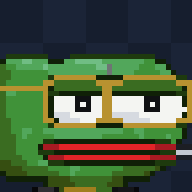
483 hand-built pixel traits across skins, suits, neckwear, glasses, hats, mouths and offices, drawn on a 48 by 48 grid.
100 frogs are one of a kind with props no other frog can have, and they are not held back: they sit in the same pool as the rest and go to whoever mints them. Every trait was drawn by hand to the same rules, so the whole set holds together.
What do they trade?
Tokenized stocks, the same ones that trade on Robinhood Chain: NVDA, AAPL, MSFT, AMZN, META, TSLA, GME and PLTR. Prices come from the pools those tokens actually trade in, which is why the frogs can work at three in the morning.
Other collections here hold these stocks. Our frogs work them. Each character has its own universe: the careful ones stay in mega caps, the degens live entirely in TSLA, GME and PLTR.
What is a Desk?
Every frog is hired to an exchange desk, fixed at mint: Nasdaq, NYSE, Shanghai, Tokyo, Hong Kong or London. Staffing follows real trading volume, so most frogs sit in New York and a London desk is genuinely rare.
The desk is a shift, in real exchange hours. A Tokyo frog works while London sleeps and New York takes over in the afternoon. Off its own shift a frog does not stop, it works the thin overnight book at a third of the weight, which is why something is always happening.
Which chain is this on?
Robinhood Chain. It is a layer 2 that settles on Ethereum, and gas is paid in ETH, so nothing about connecting a wallet or paying is unusual.
Network name Robinhood Chain, chain id 4663, which spells HOOD on a phone keypad. If your wallet does not have it yet, the mint page adds it in one click.
When is mint?
September 1. The art and the engine are finished, minting runs on OpenSea, and the mint is $3 with a cap of three per wallet.
The mint is fully public: no allowlist, no phases to game, first come first served, three per wallet.
Are the frogs trading already?
Not yet, and there is a reason. Frogs trade real money, so they cannot start before there is any: trading opens at the first payday, once $702K of $FROLLAR has traded, and the bar on the front page shows exactly how far off that is.
The engine itself has been running against live prices for months and every session it produced is stored with the exact prices it used, so the machine is not a mockup. What is waiting is the money, not the code.
What is the broker wallet on my frog's page?
Every frog owns an on-chain wallet through ERC-6551, the standard the top collections on this chain use. There is no key to hold or lose: whoever owns the frog controls the wallet, and selling the frog sells everything inside it, automatically.
It exists so payouts have somewhere real to land. Every payday the $FROLLAR fee arrives there as ETH, and that is the money the frog trades with. Nobody but the frog's owner can move it, and the contract that distributes it has no withdraw function of its own: money leaves it only into frog wallets.
What do the badges mean?
They say how a frog reached a senior seat. A Service Medal means it traded its way there. A Golden Spoon means capital bought the seat, and the badge admits it openly.
They live on the board and on the frog's page, not in the token. The artwork is frozen at the reveal, so nothing about what you own changes after you buy it.